
Bulking Supplement Stack Guide: Practical Supplements That Support Muscle Growth

Here is a thing that happens. A person decides to get serious about building muscle. They go online. They read seventeen contradictory articles. They end up at a supplement store standing in front of a wall of products, each one promising to be the thing that finally unlocks their potential, and they buy six of them more or less at random and hope for the best.
This does not tend to work out.
This Bulking Supplement Guide is here to help guide you.
Why Any of This Matters
Okay so muscle growth. In theory it is simple. You lift heavy things. You eat enough food. You sleep. You repeat this process until you look different. Great. Wonderful. Very straightforward.
Except then real life shows up.
When bulking, real life, it turns out, does not care about your protein targets. Real life has you skipping meals and staying up too late and sitting in traffic when you should be recovering and eating a gas station sandwich at eleven at night because that was genuinely the best available option. Real life makes you sore for four days after a hard session and then you miss training and then you feel bad about missing training and then you eat the gas station sandwich again.
The point is, gaps appear. Between what you intend to do and what you actually do, there is often a considerable distance. Supplements, when chosen thoughtfully and used consistently, can help close some of those gaps.
Start Here: Protein and Creatine
If you take nothing else from this bulking supplement guide, take this. Two supplements. That is the whole foundation. Everything else is optional.
Protein
Here is the number that surprises people. To actually support muscle growth you need somewhere between 1.6 and 2.2 grams of protein per kilogram of bodyweight per day. Go ahead and do that math right now. It is probably more than you thought.
Food is, genuinely, the best option. The issue is that food requires planning and time and access to a kitchen and some days none of those things are available.
This is what whey protein is for.
It is not magic. It is not a shortcut. It is protein that is fast and convenient and dissolves in water and takes thirty seconds to prepare and does not require you to locate a pan. After training, when your muscles are in a state of heightened receptivity and you need amino acids relatively soon, a shake does the job without requiring anything of you except the ability to shake a bottle. Most people can manage that.
Creatine
Creatine is interesting because it does not feel like anything at first. You take it and then a week passes and you do not feel different and you start to wonder if you bought the wrong thing.
What it is actually doing is quiet and incremental and easy to miss.
Your muscles run on ATP. Creatine helps your body regenerate ATP faster during short intense efforts. In practical terms this means that on a hard set, near the end, when your body is arguing with you about whether another rep is really necessary, creatine gives you a small additional resource to draw from. One more rep. Maybe two. Form holds together a little longer.
It is modest.
But those extra reps accumulate across weeks and months of training into additional volume, and additional volume over time is more or less how muscle growth works. So while bulking, the thing that sounds like nothing is actually, quietly, doing quite a lot.
Five grams per day. Every day. No loading phase required. It is one of the most studied supplements in existence and the safety profile is essentially impeccable. You will not feel it working. It will be working anyway. Curious about the science can look at this overview, see: Creatine supplementation and muscle performance review
A simple routine that holds up in real life looks like this: protein shake after training, creatine every day with whatever you are already drinking, real food covering the rest as best you can manage. That is genuinely sufficient for most people to make meaningful progress.
Carbohydrates: When Eating Enough Becomes the Actual Problem
Nobody tells you this before you start bulking. Eating enough is hard.
The first week is fine. Eating more than usual feels almost pleasant. Then your target calories climb toward three thousand a day and your body, which has opinions about this, starts pushing back. You are full. You are always slightly full. You sit down to a meal you need to eat and your stomach regards it with something approaching hostility.
Liquid carbohydrates help here in a way that additional solid food cannot.
They digest quickly. They do not require your appetite to cooperate. According to Pubmed, carbohydrate intake and glycogen recovery research, they replenish glycogen, which is the stored fuel your muscles run on during training, and low glycogen is one of the main reasons workouts sometimes feel inexplicably terrible. Everything feels heavier than it should. Your strength is not where it was. You cannot figure out why and the answer, often, is that your glycogen stores are just low and your body is operating with insufficient resources.
Maltodextrin, cyclic dextrin, blended carb powders. They all do roughly the same thing. You mix them into your shake or drink them before training or after, depending on what works for you. Not everyone needs this. If you are hitting your calories comfortably through food, skip it entirely. But if you are grinding against your calorie targets every day and your workouts feel flat, this is a reasonable and inexpensive thing to try before assuming something more complicated is wrong.
Recovery: The Part That Actually Determines Whether Any of This Works
Here is something that takes people a while to understand. Training does not build muscle. Training creates a stimulus. Recovery is where the actual adaptation happens. The muscle grows during the rest, not during the effort.
Which means that if recovery is compromised, the training mostly just makes you tired.
People figure this out eventually, usually after a period of pushing harder and harder and getting less and less in return and feeling confused and vaguely demoralized about the whole enterprise.
BCAAs get marketed aggressively in this category. Leucine, isoleucine, valine, the whole trio. And leucine genuinely does play a role in triggering muscle protein synthesis. But here is the thing. If you are already hitting your protein targets, adding BCAAs on top of that does not do very much. This surprises people. Essential amino acids tend to make more sense if you want something in this space, because they cover everything your body needs for repair rather than just a portion of it.
Electrolytes are almost always overlooked and are more important than people realize. When you sweat you lose sodium and potassium and magnesium, not just water, and when those minerals get depleted your performance drops and your recovery slows and you feel off in ways that are hard to identify. The fix is simple and inexpensive and most people never think about it until something feels wrong and they have already ruled out everything else.
Sleep. Sleep is not a supplement and it does not belong in a supplement guide and yet here it is because it cannot be left out. No supplement compensates for poor sleep. Magnesium can help you wind down and get to sleep more easily, which is genuinely useful, but it is supporting a process that has to exist in the first place. If your sleep is consistently bad, that is the problem to solve. Everything else is secondary to it.
The Advanced Stuff: Fine, But Only After the Foundation Is Solid
Some people, once the basics are working, want to see what else is available. This is a reasonable impulse. Just go in with appropriate expectations.
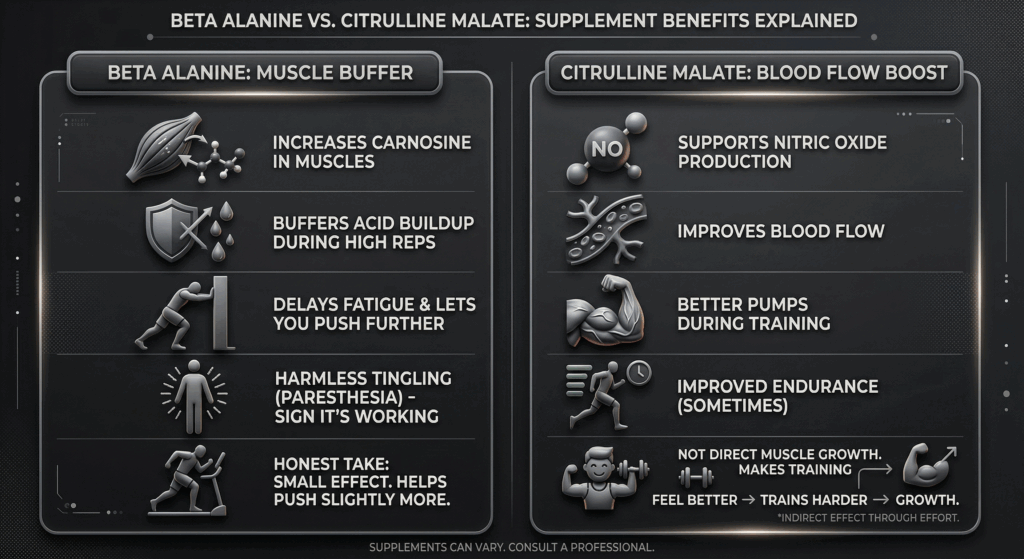
Beta alanine increases carnosine in your muscles, which helps buffer the acid buildup that causes fatigue during high rep work. You will know it is doing something because of the tingling, which is harmless but startling if you are not expecting it. The effect is not large. During conditioning work or higher rep sets, some people find they can push a little further before the wheels come off. That is the honest version of what it does.
Citrulline malate improves blood flow by supporting nitric oxide production. The most noticeable effect is better pumps during training and sometimes improved endurance. It does not directly cause muscle growth but it can make training feel better, and training that feels better often leads to training harder, which does eventually lead to muscle growth. So there is a connection there, just not a direct one.
Pre workouts put caffeine and beta alanine and citrulline and a few other things together in one product. They work. A strong cup of coffee also works and costs considerably less. Either option is fine. Neither one is necessary.
Mass gainers exist for people who genuinely cannot eat enough calories through food alone. They are useful for that specific problem. They should not be the first solution you reach for. Whole food is better when you can manage it. Use gainers when you cannot.
None of this replaces the foundation. If protein and creatine and sleep and recovery are not handled, adding beta alanine on top of a broken foundation accomplishes very little.
How to Actually Put This Together
The framework is simple. You are solving problems, not collecting products.
Cannot reliably hit your protein? Whey protein helps to fix that.
Want better performance and compounding strength gains over time? Creatine, daily, indefinitely.
Struggling to eat enough to support growth? A carb powder around training can help bridge that gap.
Feeling beaten up and slow to recover? Before you buy anything new, look at your electrolytes, your amino acid intake, and most importantly your sleep.
Want a little extra in the gym and the basics are genuinely solid? Then beta alanine, citrulline, or a pre workout becomes a reasonable conversation.
Each thing in your stack should have a specific job. If you cannot explain what problem a supplement is solving, you probably do not need it. The shelf full of impressive looking products is not the goal. Consistent training supported by a few things that actually work is the goal.
The Short Version
Supplements do not build muscle. You build muscle. Training and food and sleep build muscle. Supplements make it a little easier to do those things consistently when life is being difficult, which it often is.
Start with protein and creatine. Handle your recovery. Add carbs if the calories are a problem. Consider the advanced options only once everything else is working.
And then, mostly, just keep going. The results are in the consistency, not the stack.
Read More: